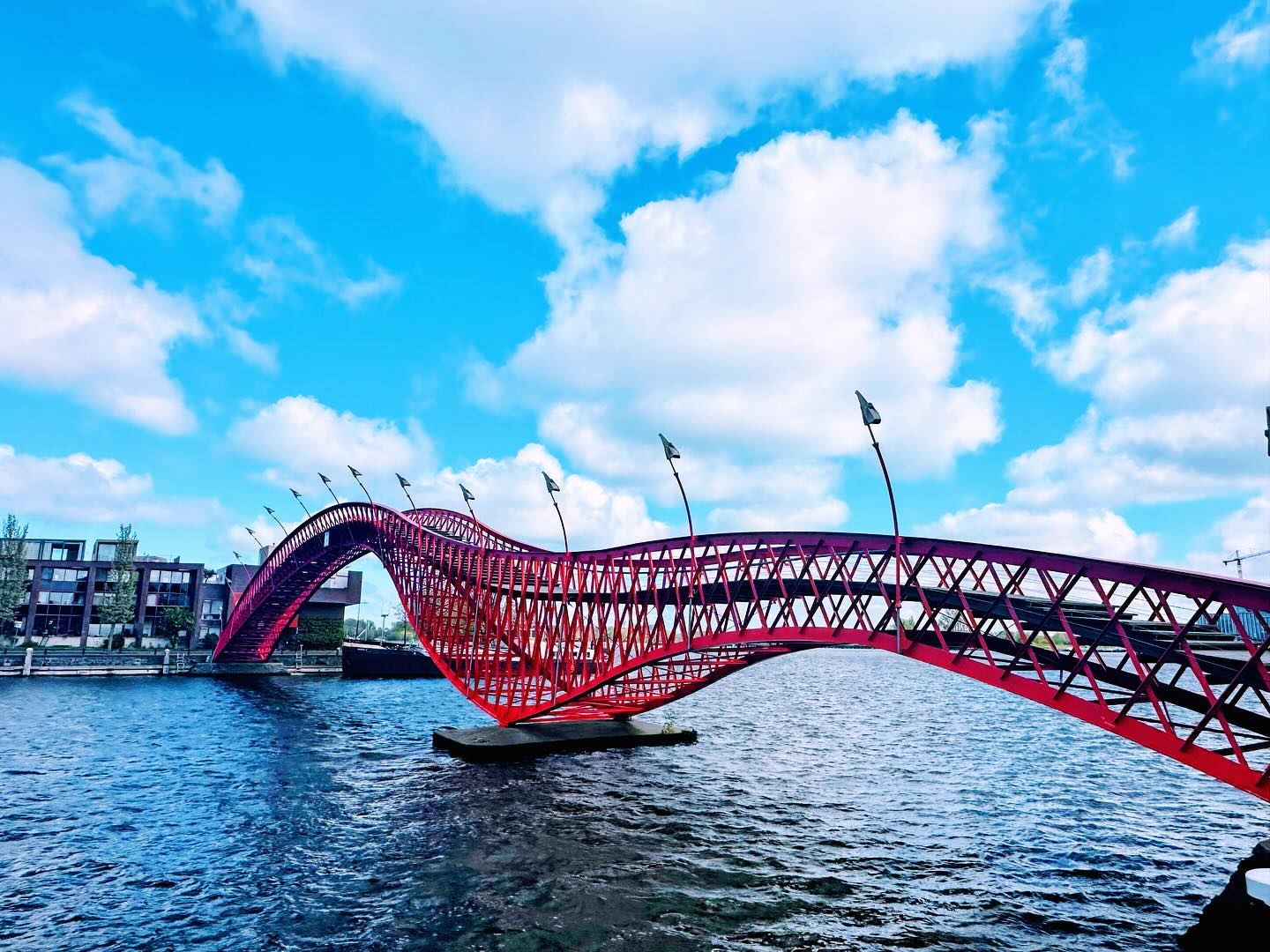
I had no idea an International Footbridge Award existed until I stood in front of the reason it does. The Python Bridge on Amsterdam's Java-eiland won it in 2002, and once you walk the full coiled loop of that red steel structure, the honor makes complete sense. Photographs reduce it to something merely quirky, a visual curiosity you scroll past. On foot, crossing and doubling back, you feel the scale through your legs and your sense of proportion quietly rearranges itself. I have been to Amsterdam four or five times over the years, and I am willing to say plainly that if you spend three days cycling only between the Rijksmuseum and the Anne Frank House, you are walking away from the more interesting version of the city entirely untouched.
The Eastern Docklands are where Amsterdam stops performing for visitors and begins simply being itself. A fifteen-minute walk east from Centraal Station, or a short tram ride, puts you on Java-eiland and KNSM-eiland, neighborhoods rebuilt through the 1990s and early 2000s when the city made an unusual decision: hand serious architectural commissions to serious architects rather than to developers working from spreadsheets. The result is coherent and genuinely livable in a way that almost no post-industrial urban redevelopment manages to be. Borneo-Sporenburg, the residential peninsula nearby, is a legitimate case study in urban density done right. None of it is traditionally pretty. There is no canal-house charm, no gabled skyline doing its postcard routine. What you get instead is a city that solved a genuinely hard problem with intelligence and care, and if you have any interest in how urban space actually functions for the people inside it, the Docklands will hold your attention considerably longer than you expect.
After the walk, do not eat in the Docklands themselves. Stay hungry and head instead to Brouwerij 't IJ, the brewery occupying a converted windmill on the Funenkade, which is barely a detour on any reasonable route back toward the center. Order the IPA, ask what else they have on tap that day, and sit outside if the weather gives you the slightest justification. It is one of the better afternoon drinking situations in Amsterdam, and the windmill setting, which reads as a gimmick on paper, turns out to be completely genuine and a little wonderfully absurd. For lodging, put yourself in the Jordaan or somewhere near Leidseplein. The blocks around Centraal Station are logistically convenient and almost uniformly overpriced for what you actually receive. Budget between 150 and 220 euros a night and you will land within walking distance of the canal belt, Vondelpark, and every restaurant worth your time. The canal boat tour can be skipped without a second thought. You will spend two hours seated at low speed watching other tourists photograph bridges you could simply be standing on.
Rent a bike on your first full morning, keep your phone in your pocket for the first hour, and let the city's layout teach you directly. Amsterdam becomes legible faster than almost anywhere I have traveled once you are moving through it under your own power. Go to the Docklands before you go anywhere else, and do not leave without walking the Python Bridge at least twice.